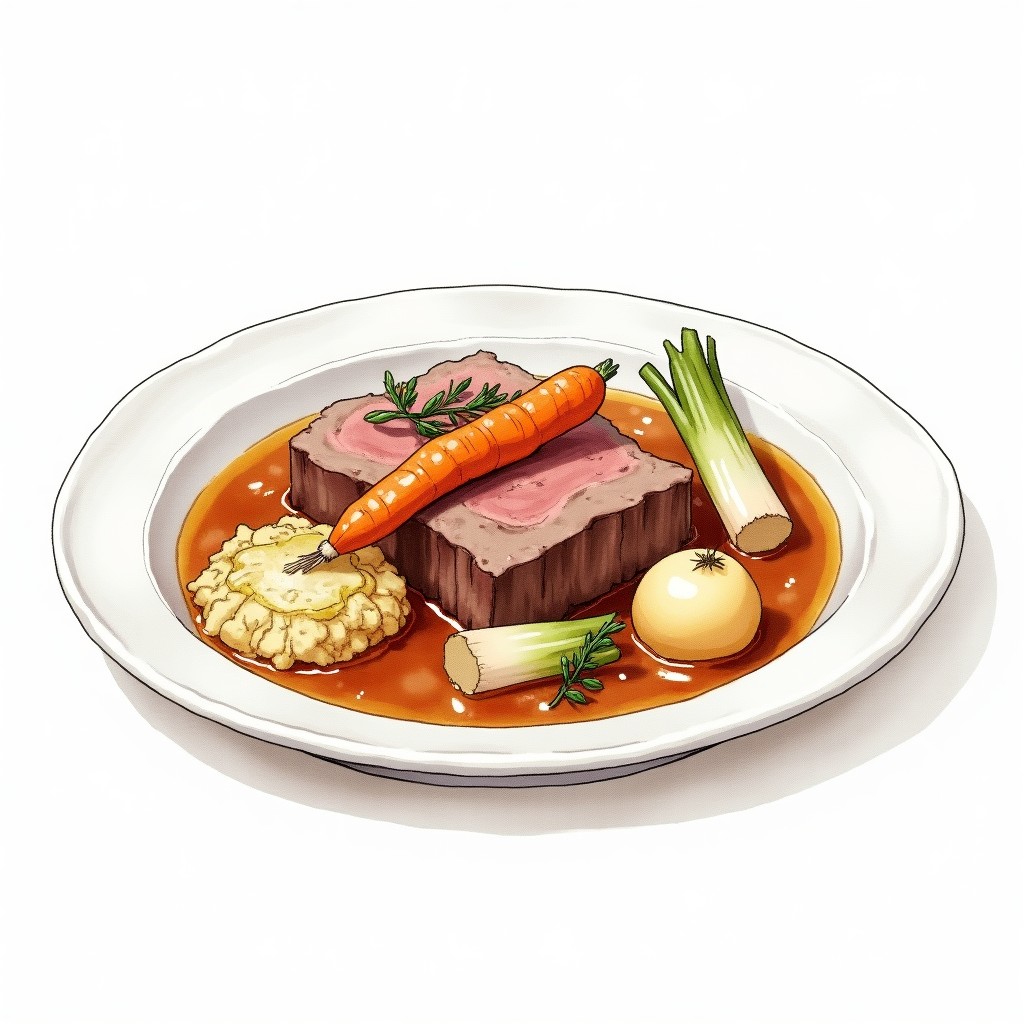
Classic French Pot-au-Feu
Rustic French Pot-au-Feu — The Ultimate Comfort Feast That Feeds Body and Soul
This centuries-old French tradition turns simple ingredients into a celebratory meal through gentle simmering and patience. The rich, golden broth serves as the first course, followed by tender beef and vegetables that practically fall apart at the touch of a fork.
Every French grandmother has her pot-au-feu story, and most involve Sunday afternoons when the house filled with the smell of slowly simmering beef and vegetables. This isn't just a recipe — it's a ritual that turns humble cuts of meat into something celebratory through nothing more than time, water, and patience.
The magic happens in two distinct acts. First comes the broth, a golden elixir that emerges after hours of gentle bubbling. French families traditionally serve this as a light first course, savoring its deep, mineral richness before the main event. Then comes the grand presentation: platters of fork-tender beef and vegetables that have given their essence to the broth but retain their own character and texture.
What makes pot-au-feu special isn't complexity — it's restraint. No browning, no searing, no fancy techniques. Just cold water, quality meat with bones, and vegetables added at precisely the right moments. The marrow bones are crucial here, lending body and richness that turns simple water into liquid gold. This is French cooking at its most fundamental: transforming the ordinary through patience and respect for ingredients.
The accompaniments matter too. Those little dishes of Dijon mustard, cornichons, and coarse salt aren't afterthoughts — they're integral to the experience, offering bright, acidic counterpoints to the rich, savory meat and vegetables. Each bite becomes customizable, letting diners create their own flavor combinations throughout the meal.
Nutrition
Ingredients
Meat
- 2 lbbeef chuck roast, cut into large chunks (2-3 inch pieces work best)
- 1 lbbeef short ribs, bone-in for richness
- 1 lbmarrow bones (ask your butcher to cut them lengthwise)
Vegetables
- 4 largelarge carrots, peeled and cut into 3-inch pieces
- 3 largelarge leeks, white and light green parts only, halved lengthwise
- 4 mediummedium turnips, peeled and quartered
- 1 smallsmall cabbage, cut into wedges (leave core attached)
- 12 smallsmall new potatoes, scrubbed but not peeled
Aromatics
- 1 largelarge onion, halved and studded with 3 whole cloves
- 1 bunchfresh thyme sprigs
- 3 bay leavesbay leaves, preferably Turkish
- 6 sprigfresh parsley sprigs (save some for garnish)
- 1 tbspblack peppercorns, whole
Seasoning
- 2 tbspcoarse salt (kosher or sea salt)
Condiments
- Dijon mustard for serving
- cornichons for serving
- coarse sea salt for serving
Instructions
- Arrange the beef chunks, short ribs, and marrow bones in your largest stockpot or Dutch oven. Pour in enough cold water to cover everything by 2 inches — starting with cold water helps draw out impurities gradually.
- Bring everything to a rolling boil over high heat, then start your skimming routine. Use a ladle to remove the gray foam that rises to the surface — keep at this for the full 10 minutes, as removing these impurities now means clearer broth later.⏱ 10 min
- Drop in the clove-studded onion, thyme bundle, bay leaves, parsley, peppercorns, and salt. Turn the heat down to low until you see just gentle bubbles breaking the surface — a hard simmer will make the meat tough.
- Cover the pot partially (leave it slightly ajar so steam can escape) and let it bubble away peacefully for 2 hours. Check every 30 minutes or so to skim any foam and make sure the simmer stays gentle.⏱ 2 hrs
- Add the carrots, leeks, and turnips to the pot — these sturdier vegetables can handle the longer cooking time. Keep that gentle simmer going for another 30 minutes until they start to yield to a fork.⏱ 30 min
- Now for the cabbage and potatoes — these cook faster, so they go in last. Nestle them into the broth and simmer until the potatoes pierce easily with a knife, about 20-25 minutes depending on their size.⏱ 25 min
- Using a slotted spoon, carefully lift out the meat and vegetables and arrange them on a large platter. Strain the precious broth through a fine-mesh sieve into a clean pot — this golden liquid is half the magic of the dish.
- Serve this feast the traditional way: ladle the hot, aromatic broth into bowls as your first course, then present the meat and vegetables as the main event alongside small bowls of Dijon mustard, cornichons, and coarse salt for everyone to customize their bites.
Tips & Tricks
- Start with cold water to help draw out impurities gradually — hot water sets the proteins too quickly and makes cloudy broth.
- Keep your simmer truly gentle; violent bubbling will make the meat stringy no matter how long you cook it.
- Don't skip the marrow bones — they're what transforms plain broth into something rich and gelatinous when cooled.
- Add vegetables in stages based on cooking time: root vegetables first, then cabbage and potatoes last to prevent mushiness.
- Save some of that strained broth — it keeps for days in the fridge and makes an incredible base for other soups.
Frequently Asked Questions
Can I make this ahead of time?
The dish actually improves overnight — the flavors meld and the broth becomes even richer. Reheat gently and add fresh herbs before serving. The vegetables may be softer, but that's traditional for pot-au-feu.
What if I can't find marrow bones?
Ask your butcher to cut beef leg bones lengthwise, or use soup bones with some marrow visible. In a pinch, extra short ribs will add richness, though the broth won't have quite the same body.
Why is my broth cloudy even after skimming?
Either your simmer was too vigorous or you didn't skim thoroughly in the first 10 minutes. Cloudy broth still tastes great — strain it through cheesecloth if appearance matters for your presentation.
Can I use a slow cooker instead?
Yes, but you'll lose some control over the process. Brown the meat first for better flavor, then cook on low for 6-8 hours, adding vegetables in the final 2 hours.
How do I know when the meat is done?
It should yield easily to a fork but not fall apart completely — you want tender pieces, not shreds. The chuck roast typically takes the full cooking time, while short ribs may be ready sooner.